Weaving Sustainability
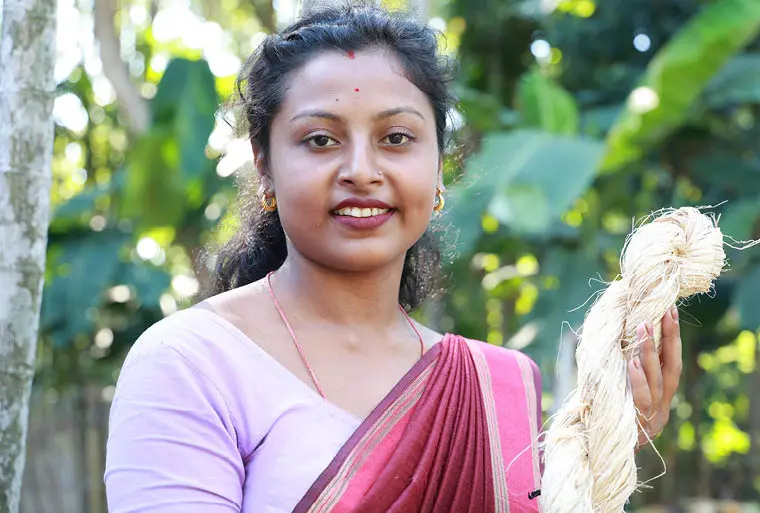
“I bought Mekhela Chador for myself with my first earning as an artisan and entrepreneur,” Jyotimoni says shyly. She further details, “I got married right after 12th grade and it ended my education journey. Caught up in the early years of married life and motherhood I didn’t work for a while.” The twenty-six-year old lives with her husband, son and in-laws. A few years ago, to earn a better living for the family, Jyotimoni tried starting a small business with her husband. “We opened a store selling mobile phone accessories. But the business never took off as there were not many buyers in this village area. We had to close it,” explains Jyotimoni.
Failures are great learning experiences. They can be stepping stones for success. Jyotimoni resonates with sentiment, “My failed first business attempt taught me that to succeed at any kind of business one needs to understand the market needs and the scope of business.”
Jyotimoni decided to explore the opportunity of being part of the Disha Project when she heard about it. “I took their threeday training which opened my eyes to the plethora of possibilities. I learnt about how to run a business,” she explains.
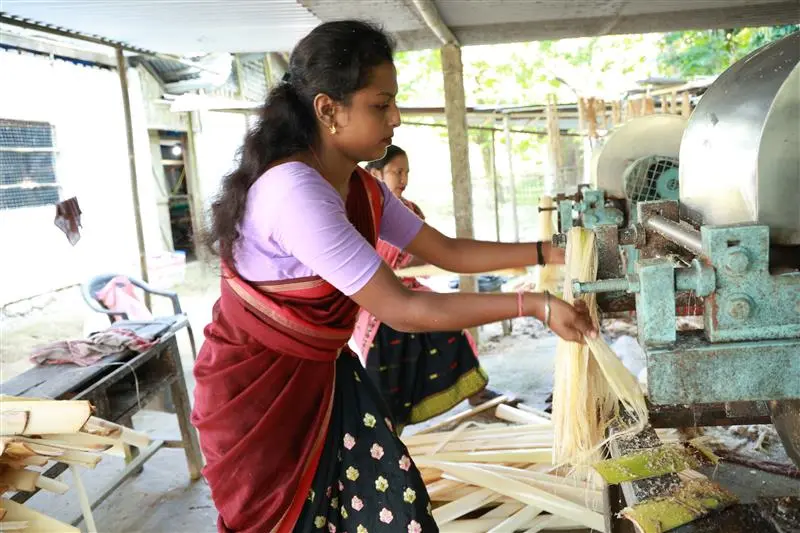
Jyotimoni decided to work with banana fibre. In a 12-day skill development training programme organised by the Project in Chamoguri village in Jorhat, Jyotimoni, along with twenty-nine other women, learnt to extract banana fibre and create marketable handicraft items from the fibre.
The training programme was comprehensive, blending theoretical knowledge with handson practical sessions. Jyotimoni reflects, “I gained practical skills in operating the Raspador machine (a machine specifically designed for banana fibre extraction) for safe and efficient fibre production. We were also trained in craft including the foundational techniques like creating the ‘3-Layered Mota Beni Chain’ and made to practise crafting the base structures for products such as handbags, fruit vases and water bottle holders.” To further enhance their creative potential, the training programme introduced participants to dyeing techniques, with a focus on preparing blue dye for their fibres. The training was provided by Khadi and Village Industries Commission (KVIC) with certified trainers.
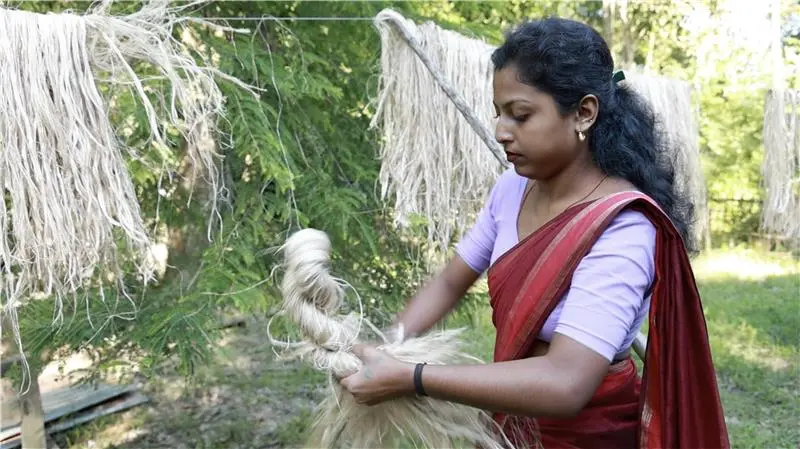
Jyotimoni finished her training in September 2024. While excitedly narrating about the making of her products, Jyotimoni explains, “The process for making banana fibre involves cutting the banana plant, separatingthe sheaths (or stem), extracting the fibres and then drying and weaving the fibres.”
Banana fibre is versatile as it has high tensile strength, flexibility and is biodegradable. According to her, “Even the waste produced during the process of banana fibre extraction can be used to feed cattle. I am able to support my family’s welfare and have the power to purchase things for myself by making Rs 7,000– 9,000 every month.” Jyotimoni is making and selling banana fibre crafts to Indian Institute of Entrepreneurship’s Incubation Centre in Guwahati.
“It is liberating to take care of myself and my family’s needs. I am proud of myself for not only becoming independent, but also making a living by creating sustainable products and can have long lasting benefits,” Jyotimoni concludes.